Choosing a valve that is one size too small can turn an ordinary shut-off point into an ongoing leak, slowest-moving component in the process and a frequent source of expensive maintenance. Valves work hard under heat, pressure and at times a sandy or saline fluid on Saudi water networks, oil and gas facilities, HVAC plants and fire protection systems. That is the reason why the gate valve vs ball valve question comes up in everyone’s project. These two valves both prevent flow… just not in the same way. Below, you’ll see how both valves work, where each fits best and how to choose with ease. Visit our page if you want to buy gate valve and ball valve.
What Is a Gate Valve?
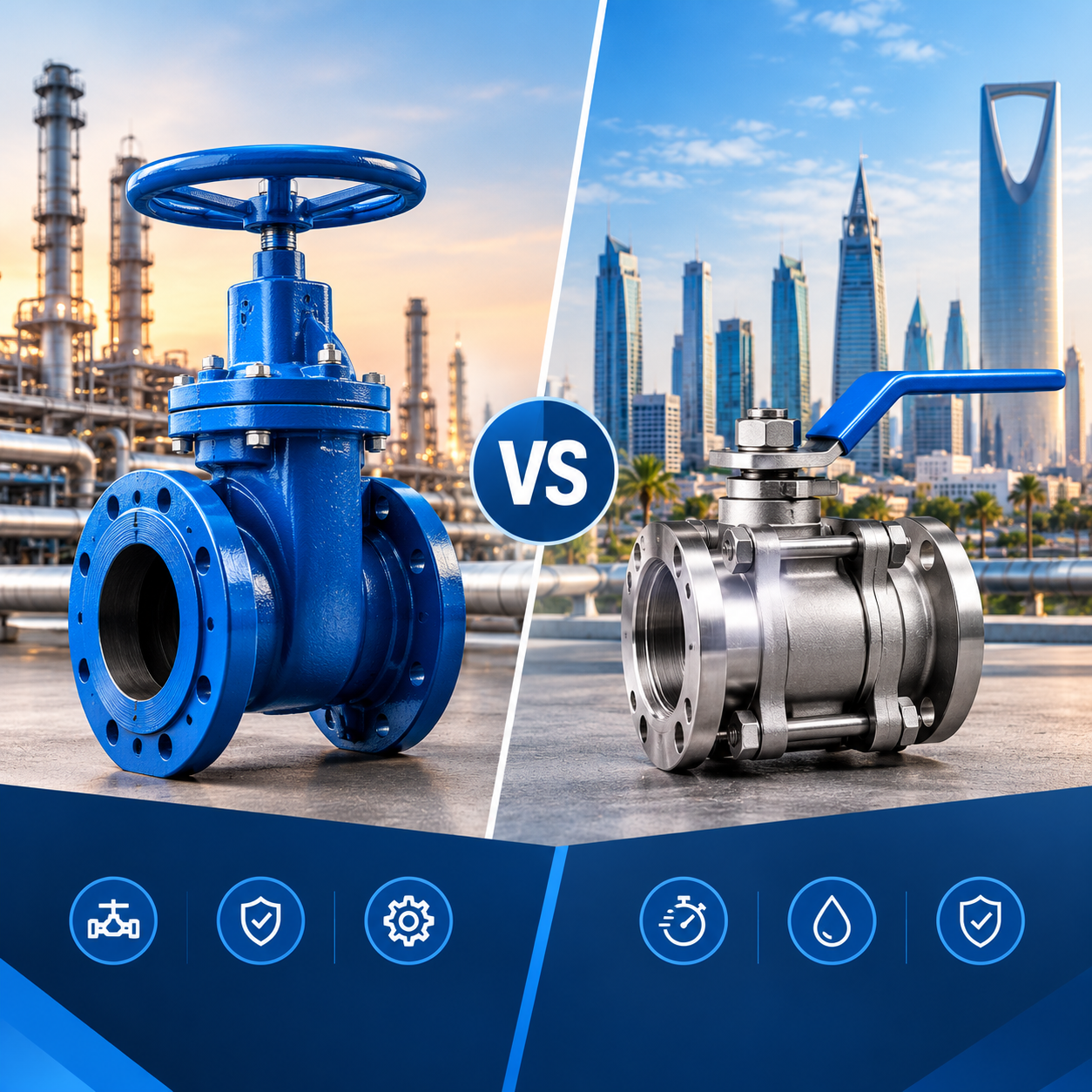
Gate valve: controls flow through rising or lowering a flat/ wedge-shaped gate within the body. The handwheel opens the gate to completely free movement out of the flow path, allowing fluid through without hardly any obstruction.
Gate Valve: It is designed to be either fully open or completely close. It is a widely used coating on water mains, process lines, fire fighting systems and all large pipes/fittings where low flow resistance is the most important factor.
What Is a Ball Valve?
The basic principle behind a ball valve is a rotating ball which has a hole through its centre – i.e. A quarter turn of the handle aligns the bore with the pipe to open the valve, and another quarter turn shuts off flow completely.
A ball valve provides excellent shut-off due to soft seats that push hard against the ball. Applications include oil and gas lines, chemical plants, HVAC systems, utility lines requiring fast and reliable isolation.
Gate Valve vs Ball Valve: Key Differences
The main difference between gate valve and ball valve designs lies in how they move, how tightly they seal and how they affect flow.
| Feature | Gate Valve | Ball Valve |
| Operation | Multi-turn handwheel | Quarter-turn handle |
| Opening/closing speed | Slow | Fast |
| Sealing | Good; may weaken as seats wear | Very tight, often bubble-tight |
| Common sizes | Small to very large diameters | Mostly small to medium; large sizes need trunnion design |
| Typical industries | Water networks, fire fighting, large pipelines | Oil and gas, chemical plants, HVAC, utilities |
gate valve and ball valve uses
Gate valves suit well long water transmission lines, desalination plant headers, fire sprinkler mains and slurries or sands services as a straight path provides in these applications. Ball valves are particularly suited to gas lines, fuel systems, chilled water branches, instrument lines and any location requiring rapid and reliable isolation by an operator.
Operation (multi-turn vs quarter-turn)
Fully opening or shutting a gate valve takes several rotations of its handwheel. It is slower but reduces the risk of water hammering in large lines.
In the ball valve, a single 90-degree turned one opens and closes. Operators can see its location at a glance, important in emergencies and routine shutdown.
Sealing and Leak Tightness
Compared to other types of valves, ball valves are generally tighter sealing since the soft seats bite into the ball. Gate valves are a good seal when new, but sand or scale and continuous operation may wear the seating surfaces over time resulting in small leaks.
Pressure Drop and Flow
When we have a completely open area in case of a gate valve, it barely leaves anything into the flow path leading to a very low-pressure loss. A full-port ball valve offers the same performance, while a reduced-port ball valve creates slightly more resistance.
Throttling is not even a function of either valve. Part-open gates whine and wear fast, while partly open balls can grub up soft seats.
Size and Cost
In the case of small and medium pipe sizes, ball valves are usually compact, straightforward setup and somewhat cheap. Gate valves are typically less heavy and cheaper than large ball valves in a larger diameter, which require heavier trunnion designs to support the additional weight.
When to Choose a Gate Valve vs Ball Valve
Choose a gate valve when:
- The pipeline is large and runs mostly fully open
- Low pressure loss is a top priority
- Slow operation helps protect the system from water hammer
- The valve serves water mains, fire protection or long transmission lines
Choose a ball valve when:
- You need quick, quarter-turn isolation
- Tight shut-off is critical, such as in gas or fuel service
- Space is limited and a compact valve is preferred
- The line is small to medium in size
For mixed systems, many Saudi projects use both: gate valves on large mains and ball valves on branches, equipment connections and utility lines.
Buy Gate Valves and Ball Valves in Saudi Arabia from Shamry Trading
The right valve protects your system for years, and the right supplier makes that choice disappear. Shamry Trading supplies gate valves, ball valves and piping for industrial, commercial and oil and gas projects across Saudi Arabia. We help you parametrize each valve to match your line size, the pressure and the fluid/application involved.
Contact us today, tell us about the project requirements and get Shamry Trading to connect you with the perfect valve for all lines!
Conclusion
This valve is most effective on bigger lines that are kept fully open without any pressure drop. So, a ball valve is more suitable for fast operating and positive shut-off in small and medium lines. Knowing the gate valve vs ball valve differences in operation, sealing, flow and size helps you prevent leaks and costly repairs.
FAQs:
In what ways does a ball valve work differently from a gate valve?
A gate valve opens with several turns, while a ball valve opens with a quick quarter turn.
Does a ball valve give a tighter shut-off than a gate valve?
A ball valve usually seals tighter thanks to its soft seats.
Can a gate valve or ball valve be used to control flow?
No. Each one is meant to stay fully open or fully shut, not halfway.
Which valve is better for large water lines in Saudi Arabia?
A gate valve, because it causes very little pressure loss in big pipelines.
Why do gas and fuel lines use ball valves?
They close fast and give tight shut-off, which improves safety.